Introduction
Before joining X Engineer, I had already completed two internships totaling six months.
Yet, during my three weeks at X Engineer, I felt that what I gained across this two-month journey was no less than everything I had learned in those prior six months combined.
Let me break down this transformation across three key dimensions.
1. Evolution of Mentorship: From “Passive Execution” to “True Ownership”
Looking back at my first two internships, the absence or distortion of a proper mentorship framework was the primary reason I chose to move on:
- First Internship (Passive Spoon-Feeding & Code-Monkey Positioning): The founder sat to my right and the CTO was right across from me. Communication seemed frictionless on the surface. But I quickly realized that the instruction was purely spoon-fed—I knew precisely how each UI element should be laid out, yet no one explained why it was designed that way, and alternative solutions I proposed were dismissed outright. When leadership eventually stated, “We hired you to execute tasks, not to challenge designs or explore principles,” I realized immediately that the environment lacked room for real growth, and it was time to leave.
- Second Internship (Friendly Answers without Critical Guidance): Working remotely, I aligned well with the CTO on technical aesthetics and product vision, and the team culture was genuinely supportive. Everyone was eager to explain the pipeline and reasoning behind existing designs. However, this model still had limitations: people were primarily providing answers rather than prompting deeper reflection—“What are the potential trade-offs of this approach?” “Why wouldn’t we choose an alternative architecture?” It solved the problem of knowing what was done, but failed to push me toward exploring the essence of engineering trade-offs.
X Engineer bridged the gaps left by both experiences.
Here, mentorship is far from spoon-feeding. We are never given rigid directives on what we must do; instead, we are empowered with genuine decision-making authority: analyzing user needs independently, decomposing feature requirements, and formulating our own technical solutions.
Frankly speaking, given our level of experience, some of our early concepts must have appeared naive to seasoned mentors. Yet at X Engineer, even when we take detours or rebuild components from scratch, we are guided to understand why a redesign is necessary. From the initial requirement breakdown to ongoing feature development and eventual production deployment, our team takes full end-to-end responsibility for the outcomes. This true sense of ownership has driven transformative growth.
2. Team Collaboration: From Solo “Swiss Army Knife” to Leading Team Breakthroughs
During this internship, I naturally stepped into the role of team lead. As a student, I had never cared much for titles like “Captain”—they often felt thankless, rewarded only with superficial praise. Here, however, taking the lead felt like a natural extension of a broader technical perspective.
Thanks to my hands-on end-to-end experience—from crafting interactive frontends to designing backend API logic and deploying production services—my full-stack background allowed me to look beyond individual modules and understand the holistic mechanics of the entire pipeline. In a team setting, this comprehensive vantage point forms the foundation for sound technical selection and architectural decisions, allowing me to bring a balanced perspective to group discussions.
At the same time, I maintain a keen sensitivity to UX (User Experience) and genuine user needs. When analyzing competing products, I can quickly pinpoint friction points in their interactions, identify counterintuitive workflows, and distill core architectural patterns worth adapting and refining.
Both my teammates and I believed that combining technical breadth with product intuition would help our team avoid unnecessary pitfalls.
However, once I stepped into the shoes of a team lead with system-wide responsibility, I discovered that the process is far more demanding than simply being an individual “tech geek.” This demand manifested in three main areas:
- High-Frequency Context Switching: As a lead, I could no longer indulge in the uninterrupted deep flow state of pure coding. I had to rapidly alternate between writing code, designing architecture, unblocking teammates, prioritizing backlog items, and incorporating mentor feedback—an intensely taxing mental exercise.
- The Cost of Communication and Guidance: Knowing how to build something is one thing; guiding others to build it is entirely another. When my technical grasp or UX intuition was a step ahead of my teammates, the biggest pitfall was reflexively taking over their keyboard. I had to exercise restraint, translating architectural concepts into accessible language and guiding teammates toward uncovering the solutions themselves. This process of communication and patience is far more demanding than writing the code alone.
- Technical Accountability and Decision-Making Pressure: The team lead is the ultimate line of defense. When design discrepancies, tech stack disagreements, or scheduling delays arose, all risks converged on my shoulders. Every decision meant trading off alternative possibilities, and carrying that burden of uncertainty was unprecedented.
Despite the intensity, serving as team lead catalyzed my evolution from a “senior coder” to an “architect and leader”:
- Shifting from “Local Optima” to “System-Wide Perspective”: In solo development, I only cared about the code quality of my own module. As a lead, I learned to view systems holistically: how to manage technical debt pragmatically, how to balance delivery velocity with architectural extensibility, and how to safeguard overall system stability and user experience.
- Cultivating Authentic Technical Leadership: True leadership does not stem from authority; it is built on technical trust, transparent decision-making logic, and the ability to solve blockers for the team. Learning how to unlock teammates’ potential and foster internal trust proved to be invaluable experiences.
- Deepening Trade-Off Evaluation and Resilience: Making the right decision rather than chasing unattainable perfection within constrained time and resources. When facing conflicting team opinions or delivery deadlines, staying composed, containing losses swiftly, and recalibrating strategies built resilience that solo coding could never teach.
3. Reshaping Technical Philosophy: From “Architectural Vanity” to “User-Value-Driven Engineering”
Prior to joining Qiniu, I interviewed with numerous technology companies. Throughout those interviews, the feedback from most interviewers left me bewildered and frustrated.
Whenever we discussed the projects I had built, interviewers rarely focused on real user problems, often jumping to the hasty conclusion: “This project lacks technical depth.” They would then proceed with standard rote questions on high concurrency, massive traffic pipelines, and low-level trivia.
This left me questioning: Could a real, problem-solving application truly be worth less than an artificial high-concurrency demo?
For instance, in my earlier AHF-QDS-EOE Exam Practice System, the objective was straightforward—solving a severe pain point where students could not repeatedly practice their mistake backlog on Chaoxing during finals. As the primary user, I drove the project from requirement analysis to feature design and production deployment, completely fulfilling real-world study needs. It was practical, reliable, and solved real problems. Yet in the eyes of many interviewers, it was undervalued simply because it lacked an overly convoluted architecture.
To adapt to this interview climate, I unconsciously succumbed to technical anxiety: believing that unless a project featured cloud-native deployments, Kubernetes clusters, master-slave database replication, sharding, and dozens of microservices coupled with various message queues, it wasn’t considered “substantial.”
Before interviewing at Qiniu, when building the MPP Multi-Platform Publishing System, I was deeply swayed by this mindset:
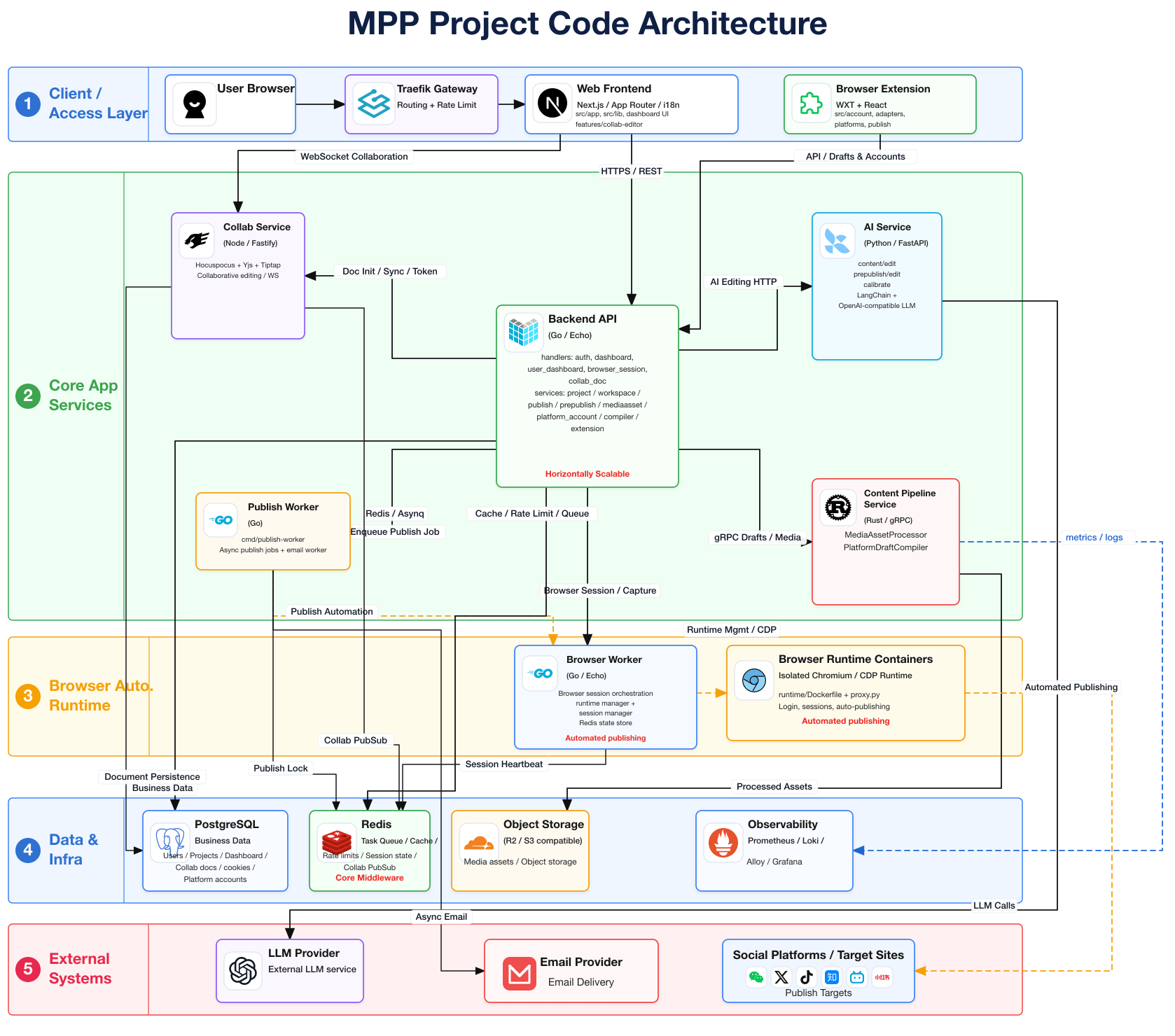
To prove my technical capability, I designed an excessively complex architecture, splitting numerous services and introducing multiple middleware layers. While it appeared “massive” and had plenty of superficial “technical depth,” it drastically increased system maintenance overhead and operational complexity. This architectural anxiety even carried over into the initial phase of our current 2D Game Asset Generation Project.
When selecting project topics, I did not initially pick this project as my first choice, believing: “It looks too simple and technically unchallenging.” Once development began, my instinct was to introduce message queues and decompose services, attempting to scale it into something as complex as the MPP system above.
It was only when my mentor intervened that I realized how deeply I had fallen into this technical trap.
My mentor prompted me to revisit a fundamental question: What is the ultimate purpose of technology?
We build products to solve real user problems, not to showcase cloud-native buzzwords, database sharding, or distributed patterns on a resume. Architecture exists to serve the business; discussing microservices and high concurrency disconnected from actual user scale is merely over-engineering detached from reality.
Conclusion
In the past, I possessed solid independent development capabilities, accustomed to analyzing requirements, identifying solutions, and tackling problems head-on. But that capability was primarily centered around “Can I get this built?”—whether I could write full-stack features, deploy servers independently, and architect a system that looked technically sophisticated.
Today, I reflect on harder questions: Is this truly worth building? To what extent should we scale at this current phase? Does the technical complexity align with the actual return on investment? Can the team understand and collaboratively maintain this solution? What does a given decision mean for user experience, engineering velocity, and future system evolution?
As a team lead, I no longer rely solely on individual output. Rather than doing everything myself, it is far more critical to build shared alignment across the team, ensure everyone takes ownership in the right capacity, and course-correct promptly when deviations occur. I must constantly weigh requirements, user experience, architecture, timeline, and team capabilities while taking final accountability. This has guided my transition from a solo full-stack developer toward someone with a true architectural perspective and leadership acumen.
Simultaneously, my definition of “technical depth” has undergone a fundamental shift. In the past, I sought validation through microservices, middleware, cloud-native tooling, and intricate architectures. Now, I understand that true technical depth is not about making simple problems complex; it is about accurately identifying the core problem, solving it with a solution well-suited to the current business stage, and understanding clearly why that choice was made and what trade-offs were accepted.
Technology is not a vehicle for engineers to prove their cleverness; it is a tool to create genuine value. Architecture is not superior because it is complex—it is superior when it reliably supports user needs, team collaboration, and sustainable product evolution.