If the Only Goal Is Generating a Pretty Image, Why Build Holonic Asset?
Anyone who has developed indie games or worked in a small team has likely experienced that familiar “AI disillusionment moment”:
You open ChatGPT or any generic image generation tool, enter a few prompts, and thirty seconds later, a breathtaking pixel knight pops onto your screen. You think excitedly: “The era of the solo indie developer has finally arrived.”
Yet the moment you try to drop that asset into a game engine, reality pours cold water over your enthusiasm:
- You want the knight to run, but the AI generates a completely different suit of armor with shifting proportions on every single frame;
- You try to generate a matching monster, but the art style diverges entirely—one has heavy black outlines while the other glows with soft highlights;
- You try to generate a set of dungeon floor tiles, only to receive a static, perspective-skewed illustration that cannot be seamlessly tiled;
- After spending hours manually slicing dozens of PNGs in Photoshop, you decide to change the knight’s hair color, forcing you to endure the exact same grueling cycle from scratch.
Generating a single pretty picture is a toy; reliably delivering a coherent, engine-ready suite of game assets is real productivity.
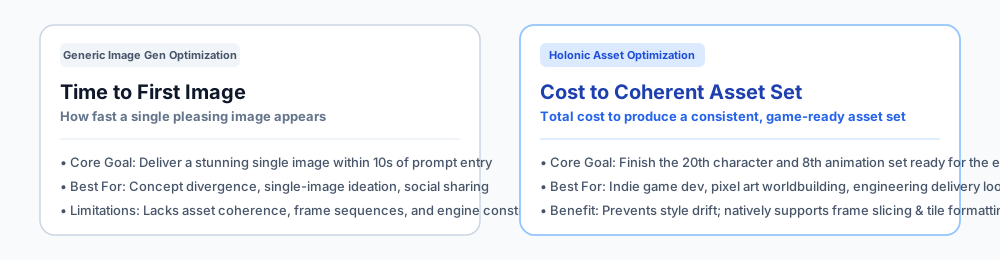
These two goals are not inherently opposed, but under constrained resources, they steer a team toward diametrically different product priorities.
This article is not a celebratory checklist of features. It is an honest record of the trade-offs we navigated while building Holonic Asset: where we chose to focus our energy, what we deliberately gave up, what costs we actively absorbed, and under what specific conditions we would revisit those judgments.
How We Define “Genuine Product Trade-Offs”
Many teams write product principles like “pursue extreme user experience”, “simple and easy to use”, or “user-first”. But such slogans offer zero guidance during actual decision-making—no team ever proclaims they “aim for a mediocre experience” or “intentionally make products cumbersome”.
When structuring this retrospective, we drew inspiration from the practices of exceptional teams:
- Intercom proposed a sharp litmus test: The opposite of a principle must also be a rational choice for another successful company. If nobody would ever pick the opposite, it is merely a platitude.
- Figma emphasizes that engineering and product values must explicitly state what the team actively sacrifices for a given choice.
- Basecamp (Shape Up) insists on treating out-of-bounds scope as a first-class citizen in product specs, written out in the open rather than swept under future roadmaps.
- Linear chooses to build early feature slices exceptionally narrow and deep rather than shipping a cluster of half-baked features that fail to validate genuine value.
Synthesizing these philosophies, we forced ourselves to answer four grounded questions for every key decision in Holonic Asset:
- What is the real-world constraint?
- What did we choose to prioritize, and what did we give up?
- What explicit costs did we accept as a result?
- What clear signal would overturn this decision?
Trade-Off 1: Dedicated to Indie Devs and Small Teams, Bypassing Generic Communities and 3A Custom Pipelines
During our initial scoping discussions, the potential user base seemed enormous: pixel art enthusiasts, indie developers, commercial game art teams, and casual prompt hobbyists.
Yet analyzing their core demands revealed that these groups live on entirely different wavelengths:
- Casual Users / Hobbyists: They seek one-click outputs, unexpected serendipity, and high-engagement social sharing. They do not care whether dimensions align with a sprite grid or whether frames can be exported cleanly;
- Commercial Game Studios: They possess mature art pipelines and prioritize deep integrations with Photoshop or Aseprite, intricate approval hierarchies, and bespoke studio workflows;
- Indie Developers / 2–5 Person Teams: They often lack a dedicated artist or operate with severely strained art bandwidth. Their core headache is: “How do we assemble a coherent, playable set of game assets within a reasonable timeline using finite manpower?”
We decisively bet all our chips on the third group.
Our Choice
- Prioritize cross-asset world consistency over single-image viral appeal;
- Prioritize frame animations, layer separation, tile grids, and engine exports over generic freeform photo retouching tools;
- Prioritize compressing total time from concept to a playable game prototype, rather than chasing sub-second raw generation speeds for a single picture.
The Costs Accepted
Our addressable market narrowed considerably. When demoing to people outside game development, it is difficult to elicit a “wow” from a single standalone still image—the value of Holonic Asset is hidden in the grind: “The art style still holds together on the 20th item” and “A single export plays seamlessly inside Godot or Unity”. Furthermore, initial onboarding requires understanding projects, perspective, and asset taxonomies, creating a steeper learning curve than standard text-to-image apps.
Reconsideration Trigger
If core indie developers are shipping full asset suites reliably but top-of-funnel growth hits a hard ceiling, we will consider expanding into adjacent creative use cases. However, until the primary production loop is thoroughly proven, we will never dilute game-oriented functionality to chase casual audiences.
Trade-Off 2: Going Deep into 2D Pixel Art, Resisting the “Superficially All-Powerful” Shell Platform
When building an “AI game asset generation platform,” the easiest temptation is cramming every trendy concept onto the homepage: photorealistic concept art, anime illustrations, Live2D, UI components, sound effects, BGM, particle VFX…
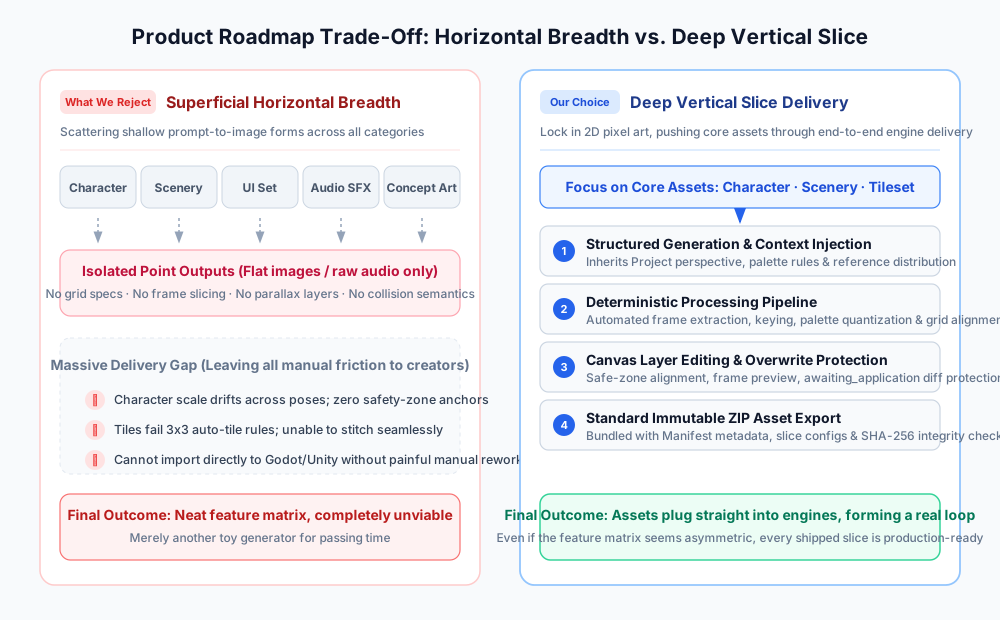
We resisted this impulse. For Phase 1, we restricted our scope strictly to 2D pixel game assets, choosing to drive a few core pipelines completely end-to-end rather than offering a wide matrix of superficial buttons that produce unusable outputs.
Why Focus Specifically on 2D Pixel Art?
The most practical reason is that current AI image generation models struggle severely with high-resolution realism in game production:
- The “AI Plasticity” and Floating Noise: High-resolution generations frequently suffer from messy noise, fuzzy silhouettes, overly smooth oily gradients, and anatomical hallucinations. Both developers and players spot them instantly as “cheap AI output”;
- Immediate Aesthetic Collapse: Stuffing a game with high-resolution, plastic-looking AI art immediately slaps the game with an “uninspired AI asset-flip” stigma.
2D pixel art sidesteps these pitfalls cleanly while offering two massive engineering advantages:
-
Deterministic Post-Processing Washes Away the “AI Look”: Pixel art is defined by discrete coordinate grids and constrained palettes. Even when a raw generative model outputs blurred gradients or noisy artifacts, our post-processing pipeline—through downsampling, frame extraction, palette quantization, and grid rasterization—deterministically strips out the oily noise, yielding clean, handcrafted game sprites.
-
Rigid, Quantifiable Engineering Constraints: Pixel art is not a subjective matter of “artistic vibe”—it follows objective, binary engineering rules:
- Grid & Dimensions: 16x16 is strictly 16x16; translucent anti-aliasing artifacts on edges are strictly forbidden;
- Palette Uniformity: All assets must share a finite color palette, or visual cohesion disintegrates on screen;
- Poses & Safe Zones: 4-direction or 8-direction characters must rigidly adhere to center-of-mass anchors and bounding boxes to prevent wild sprite jitter in-engine;
- Tileset Logic: Floor and wall tiles must cleanly decompose and seamlessly assemble according to standard 3x3 auto-tile rules.
In a realistic digital painting, a stray stroke cannot easily be flagged as a bug by code. In pixel art, a single misplaced pixel or misaligned border instantly breaks the asset in the game engine. Pixel art not only washes away the cheap plastic feel of raw AI, but serves as the ultimate litmus test for whether AI generation can function as a disciplined engineering tool.
Vertical Slices Over Horizontal Shells
In roadmap prioritization, we adhered to the principle of “mastering one pipeline before touching the next”:
- We prioritized taking Character, Object, Scenery, and Tileset through the complete chain: “Parameter Configuration -> AI Generation -> Frame Extraction / Keying / Spec Normalization -> Canvas Tweaks -> Export Packaging”;
- For categories like UI Set or Audio SFX, even though database schemas were reserved, we explicitly flagged them in the interface as “Unavailable” or “Roadmap” as long as generation quality failed production standards. We refused to build cosmetic buttons that prompt a model only to return unusable junk.
The Costs Accepted
For a long period, our UI looked “incomplete” or asymmetric. New users would occasionally ask, “Why can’t I generate background music directly?” or “Why is there no support for photorealistic character portraits?” We spent significant energy explaining our boundaries and accepted the departure of non-target users.
Reconsideration Trigger
Only when a new asset medium (such as UI vector components or 8-bit chiptunes) can be governed by quantifiable acceptance criteria, seamlessly integrating into our Project context and export contracts, will we officially open its production pipeline.
Trade-Off 3: Starting with a Project, Not a Naked Prompt Every Time
Typing directly into a bare prompt box (Prompt-first) offers the lowest possible friction for first-time users. But as soon as you attempt to build a real game this way, you discover that raw prompts have no memory.
When creating your first soldier, you carefully tune the prompt: "16-bit, top-down 45°, desert theme, nes palette". By the 10th building, you omit two keywords, and the resulting generation has a completely skewed perspective. You end up spending your entire cognitive budget in a war of attrition against prompt phrasing.
Our Choice
Holonic Asset mandates that production begins inside a Project.
When creating a project, creators first lock down the core constraints of the entire game:
- Game Type and Perspective (e.g., Side-view Platformer, Top-down 45°);
- Target Platform and Resolution Baseline;
- Project References: Establishing the global palette, pixel density, and linework aesthetic.
When subsequently creating specific Assets (e.g., a “Fire Mage”), the user only describes the character’s unique identity (“red robe, holding an ornate wooden staff”). The system automatically synthesizes the Project’s global context with local parameters.
Furthermore, we strictly decouple the responsibilities of reference images:
- Project Reference: Responsible solely for locking global art style, palette, and pixel grain;
- Creating Reference: Responsible solely for the physical appearance and identity of the current asset;
- Nexus Reference: Allows borrowing stylistic continuity from sibling assets within the same project, without altering the core subject or action.
The Costs Accepted
From registration to receiving the first generated image, users must navigate creating a project, selecting a perspective, and uploading reference art. First-image latency stretches from fifteen seconds to two or three minutes, causing noticeable drop-off among casual prompt tinkerers.
Reconsideration Trigger
If data shows significant drop-off among genuine indie developers during initial project onboarding, we will introduce a lightweight “Quick Generate” scratchpad. However, assets created in that scratchpad must be cleanly adoptable into an existing Project, rather than proliferating as isolated standalone images.
Trade-Off 4: Modeling Outputs as “Game Assets”, Not Flat Images
In most generative tools, an output is simply a URL pointing to a PNG file. This is trivial to implement on the backend, but in game development, it dumps all the heavy lifting onto downstream pipelines.
Real game assets are living, structured domain objects:
| Asset Type | Actual Structure Required by Game Engines | Consequences of Providing Only a Flat PNG |
|---|---|---|
| Character | Directional prototypes + animation frame sequences + collision hitboxes | Users must manually slice frames in Photoshop; animations easily jitter |
| Scenery | Foreground, midground, background parallax layers | Cannot implement parallax scrolling in-engine; remains a flat static backdrop |
| Tileset | Regular grids, corner slices, collision masks | Cannot be parsed by Tilemap editors; requires manual re-slicing |
| UI Set | Button states, health bar frames, 9-patch margins | Components cannot scale or bind events; remains a static mockup |
Our Choice
We modeled Assets as first-class domain entities with independent lifecycles and internal structures.
For example, we explicitly refactored generic UI into UI Set—it does not represent a static screenshot, but a collection of structured, sliced components with state variants. While this forced us to engineer dedicated schemas, canvas editors, state machines, and transformation pipelines for each asset type, it ensures that every generated output is an engine-ready half-finished product rather than a static image requiring hours of secondary rework.
The Costs Accepted
Engineering complexity expanded exponentially. Every new Asset category demands dedicated canvas layouts, timelines, and specialized processing pipelines—it cannot be treated as just another file extension in an object store.
Reconsideration Trigger
If certain game resources (such as static achievement badges) genuinely require no layering, frame sequences, or grid slicing, we will not force them into heavy Asset entities, treating them instead as lightweight attachments to avoid over-engineering.
Trade-Off 5: Human Confirmation for Modifying Existing Assets, Direct Write for New Assets
When designing Human-in-the-Loop workflows, it is easy to gravitate toward two unhelpful extremes:
- Extreme 1 (Over-Automation): The AI automatically overwrites the current asset canvas upon completion.
- Extreme 2 (Over-Bureaucracy): Prompting confirmation dialogs for every microscopic operation.
In practice, both extremes frustrate users.
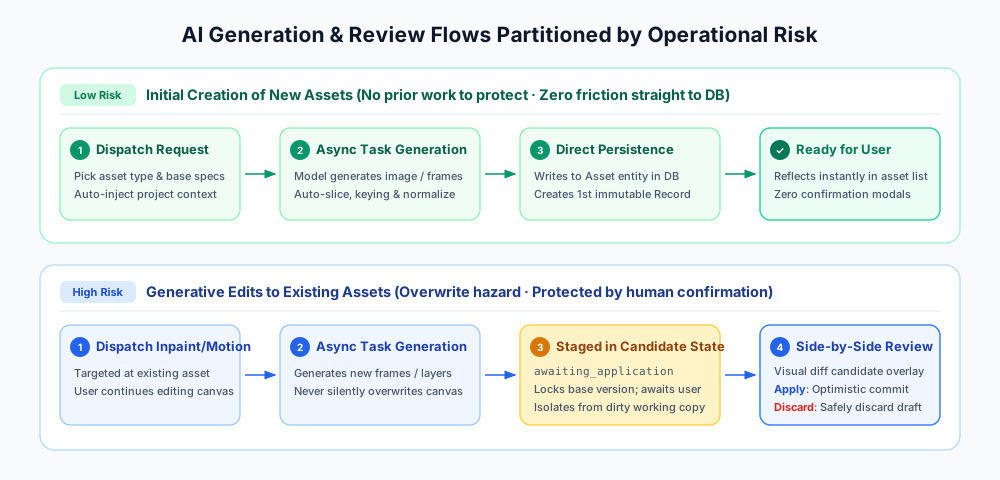
Generating sprites or multi-frame animations requires 20 to 60 seconds of asynchronous processing. If a creator is actively polishing the cloak pixels of a character while waiting, and the background task silently overwrites the canvas upon completion, ten minutes of delicate manual work evaporates.
Conversely, when clicking “Create a New Skeleton Soldier,” there is no prior work to protect. Prompting a confirmation modal asking “Do you want to save this new asset?” adds pointless friction.
Our Choice
We bifurcated permissions based on operational destructive risk:
- Generative edits on existing assets (e.g., adding animations, repainting parts): Generations enter the
awaiting_applicationstate. The editor overlays a candidate diff, requiring explicit user action to Apply or Discard; - Initial creation of new assets: When backend jobs complete, entities persist directly to the database and reflect immediately upon list refresh, introducing zero modal friction.
The Costs Accepted
The system must manage candidate states in both database and object storage, handle optimistic concurrency checks on Apply, and clean up orphaned resources on Discard.
Reconsideration Trigger
Only when operations achieve 100% millisecond-level lossless Undo, or when users explicitly authorize auto-merge for specific batch workloads, will we further streamline the review flow.
Trade-Off 6: Establishing an Engine-Agnostic Standard ZIP Contract Before Binding to Engine Plugins
When discussing game engine handoff, the immediate reflex is often: “Let’s build a Unity package or Godot one-click importer right away! Click a button and watch it run in the game—think of how great that looks in demos!”
Yet premature engine bindings quickly backfire: Unity Prefab hierarchies, Godot .tscn scene trees, and Unreal asset manifests rapidly contaminate the core domain model. When Unity deprecates an API or Godot adjusts scene serialization, engineering bandwidth gets devoured by engine compatibility maintenance.
Our Choice
We established an engine-agnostic, immutable, self-contained ZIP delivery contract at the system boundary.
Every export creates a snapshot archive of a specific, immutable historical version (Record), containing:
- Standardized
manifest.jsonandasset.jsonfiles detailing asset types, grid dimensions, frame rates, and slice bounds; - Formatted directories containing sprites, parallax layers, or packed sprite sheets;
- SHA-256 checksums to verify integrity and prevent corruption.
Whether users unzip files manually or ingest them through our upcoming CLI, SDK, or community-authored import scripts, they consume the same stable, transparent, self-describing format.
The Costs Accepted
At present, creators downloading asset packs must still drag them into their engine project and perform basic resource bindings, missing out on the immediate magic of a one-click plugin import.
Reconsideration Trigger
Once the multi-asset delivery contract has stabilized thoroughly, and manual in-engine configuration becomes the primary bottleneck for our core user base, we will develop official import plugins for major open-source engines (such as Godot). Plugins must remain downstream consumers of the contract, never the drivers of system design.
Product Decision Matrix: What We Prioritized vs. What We Postponed
| Decision Dimension | What We Prioritized (Yes) | Rational Options Postponed / Rejected (No) | Explicit Costs Accepted | Reconsideration Triggers |
|---|---|---|---|---|
| Target Users | Indie game developers and agile 2–5 person teams | Broad text-to-image communities or bespoke AAA pipelines | Narrower audience; difficult to go viral with single images | Core users form stable production loops, but top-of-funnel growth hits a ceiling |
| Asset Depth | Deep vertical slice across 2D pixel art (Character / Scenery / Tileset) | Horizontal coverage across photorealism, anime, audio, and Live2D | Feature matrix looks temporarily asymmetric and incomplete | Core pipelines proven; new mediums possess quantifiable delivery criteria |
| Creation Ingress | Mandatory Project context (locking perspective, palette, references) | Bare Prompt-first generation with zero setup | Higher onboarding friction; greater risk of casual visitor drop-off | Indie developers encounter systematic churn during initial setup |
| Asset Modeling | Structured domain entities (layer hierarchies, frame sequences, slice grids) | Flattened PNG images as the universal output | High development costs; dedicated pipelines and editors per asset type | Static standalone resources that genuinely require no internal structure |
| Human-AI Loop | Explicit confirmation for edits (preventing overwrites); direct persistence for new assets | Mandatory modal confirmations for everything, or silent overwrites across the board | Managing candidate state machines, version conflicts, and resource cleanup | Lossless millisecond undo available, or explicit user batch authorization |
| Delivery Contract | Engine-agnostic, immutable ZIP packages with standardized manifests | Early binding to proprietary Unity / Godot plugins and formats | Users must perform manual asset wiring after importing into the engine | Manifest standard is highly stable; manual wiring becomes the primary bottleneck |
Conclusion: Documenting Trade-Offs Is Not About Claiming Omniscience
When writing about product design and system architecture, it is easy to succumb to hindsight arrogance: packaging every past decision as an act of visionary foresight, and reframing missing features as “strategic restraint.”
Real product evolution is never so tidy.
Choosing Project-first may indeed overestimate user patience; doubling down on structured pixel assets placed a massive engineering burden on our early team; and holding back on engine plugins undeniably reduced initial demo flashiness. These are real risks and real costs.
Documenting these trade-offs is not about presenting ourselves as holders of immutable truth, but about holding up a mirror for our team:
We know precisely whose problem we are solving, we understand the shortcuts we chose to reject, and we know exactly what environmental shifts will prompt us to overturn our prior assumptions without hesitation.
Building assets that truly work inside real game engines, rather than manufacturing another generative novelty—that is the starting point for every trade-off in Holonic Asset.